Sir Charles Metcalfe
'In Jamaica, still convulsed by a social revolution, he calmed the evil
passions which long suffering had engendered in one class, and long
domination in another.' (from his memorial tablet.)
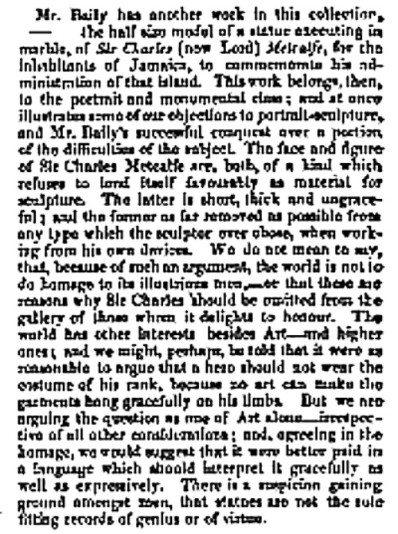
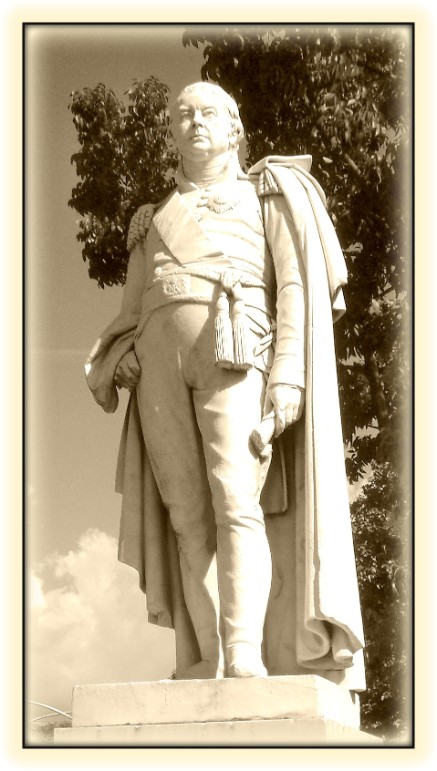
A writer in the May 1845 issue of The Athenaeum, Journal of literature , science and the fine arts had a somewhat amusing comment on the statue of Metcalfe by Edward Hodges Baily, of which a half-size model was included in the Royal Academy exhibition that year.
The North British Review, Vol 22, 1855
EDINBURGH: W. P. KENNEDY, SOUTH ST. ANDREW STREET;
LONDON: HAMILTON, ADAMS, AND CO.;
DUBLIN: JAMES M'GLASHAN.
(from review article)
The Life and Correspondence of Charles, Lord Metcalfe; late Governor-General of India, Governor of Jamaica, and Governor-General of Canada; from Unpublished Letters and Journals preserved by Himself, his Family, and hit Friends. By JOHN WILLIAM KAYE Author of the "History of the War in Afghanistan." 2 vols. London, 1854
'Probably no more difficult task could have been devolved on a man than the government of Jamaica at that moment. Six years had elapsed since the Negro Emancipation Act; the provisional apprenticeship-system was over; and the great party-war between the ruined planters, who saw their estates relapsing into wilderness, for want of labour, and the negroes, now in the enjoyment of plenty, without the necessity of labouring more than they liked, was raging virulently throughout the island. The stipendiary magistrates and the ministers of religion, above all the Baptist ministers, took the side of the negroes; and backed them in their continually increasing claims as against their former masters. Metcalfe's predecessor in the government, as the representative of the feelings and wishes of the mother-country at this crisis was naturally on the same side. In these circumstances, the Representative Assembly of the island, composed of planters and their agents, declared themselves in permanent opposition to the government, and had recourse to a system of dogged inertia, - that is, refused to pass any measures, or to transact any business not indispensable for cash purposes, - until the grievances of the planters should have been redressed. The Whigs at home had no option, in this dilemma, but to suspend the constitution of the island, and vest the rule in the Governor and his council of twelve, to the exclusion of the Assembly. Sir Robert Peel, indeed, turned them out on this measure; but, as he was unable to form a ministry, they returned to office, and a mild modification of the original bill passed. The real want, however, was a man to be sent out as governor, in whose hands the unconstitutional powers which the bill authorized would be safe. Sir Charles Metcalfe was chosen; the feeling being, that a man who had, in his official career among the whites and the dark skins of the East Indies, shewn such skill and tact and temper, could not feel himself quite out of his element among the whites and blacks of the West Indies. It was not expected that he or any other man could, as Governor of Jamaica, solve the great social and economical questions which were then distracting the island - that he could provide a remedy for the want of labour, and so take the sting of present local disaster entirely out of the measure which the spirit of universal philanthropy had forced upon the island for the behoof of the rest of the world. All that was expected, all that was possible, was, that by judicious and firm conduct, he should tide over the present difficulty; temper disaster as much as possible to the one party, and correct and abate as much as possible the highhanded exultation of the other; and so fairly commit the solution of the problem to the action of time and circumstance. And this work he performed most successfully. He remained in Jamaica not more than one year and a half, (October 1839 - May 1841); but during that time so strenuously did he devote himself to the task of soothing and beating down party-spirit, and so dexterously and gently did he use his power, that the unconstitutional authority with which he had been vested in case of necessity hardly made its appearance at all, and the affairs of Jamaica began once more to flow in the channel of order and routine. His chief difficulty was with the Baptist missionaries; but even with them his suavity and his firmness produced their effects; and when he left Jamaica the gratitude and respect of all classes followed him. It was felt that what it had been possible for a man in his situation to do towards expediting the solution of the grand question of the day, he had done; and, moreover, his special enactments for the reform of the judicial and administrative system of the island had been neither few nor small. At this day his memory is cherished, both by the blacks and the whites of Jamaica, as that of perhaps the best governor they have ever had.'
In 1841 an act passed the legislature, creating a distinct parish, to
be called “Metcalfe”,
from a portion of the eastern part of St. Mary and of the western part of
St. George. The parish
disappeared in 1867 when these two areas were returned to St Mary, and to Portland, which
absorbed the old parish of St George.


